App Store screenshot sizes 2026: the full spec
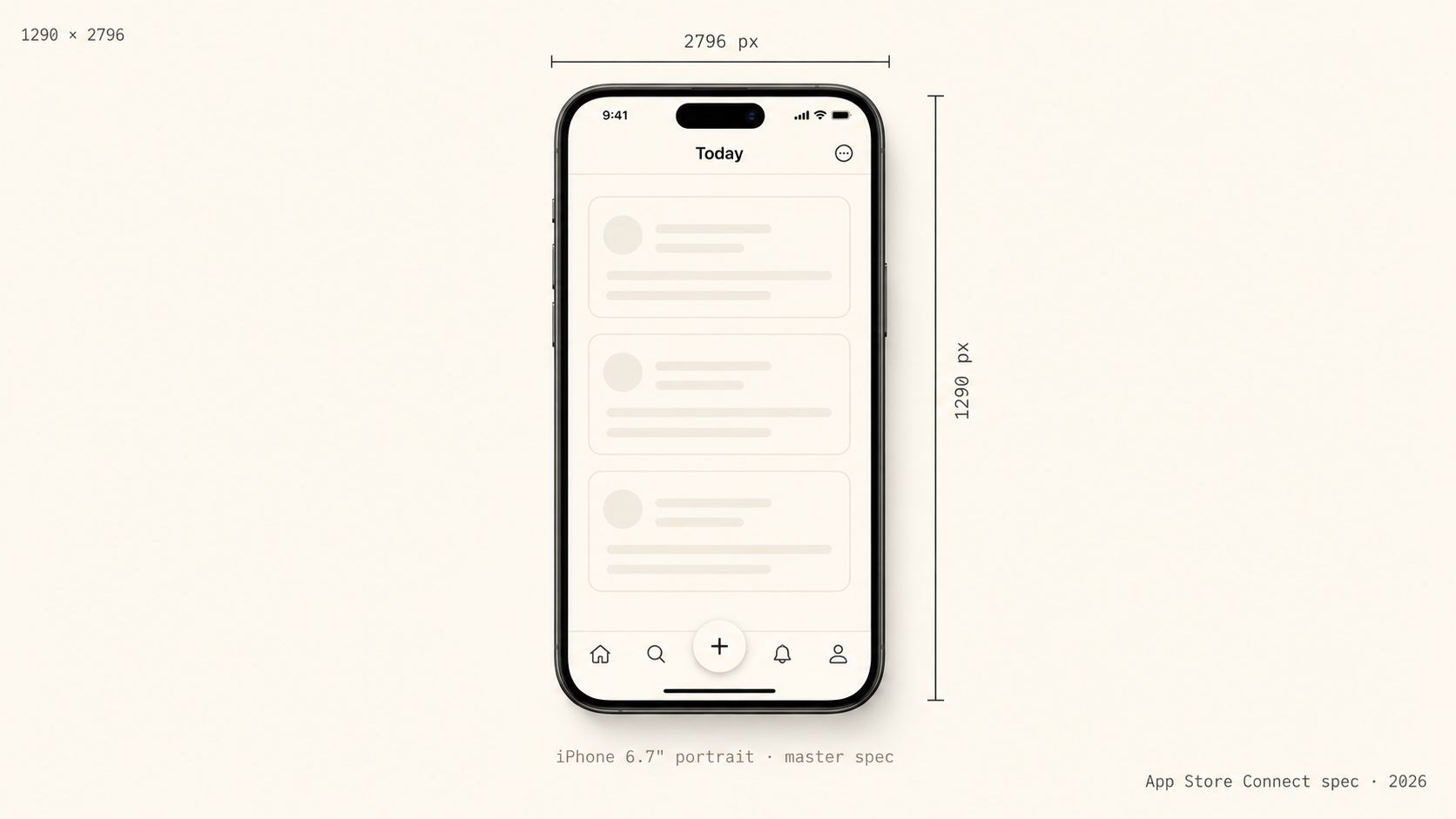
If you're shipping an iOS app to the App Store in 2026, the screenshot spec you actually have to meet is short: one set for the 6.9" iPhone display, at 1290×2796, 1260×2736 or 1320×2868 pixels portrait, PNG or JPEG, no transparency. Apple accepts all three sizes for that display class; 1290×2796 is the most common because most templates and tools (ShotStudio included) export it.
Everything else on the App Store Connect screenshot help page is either optional, derived from this size, or only applies if you're shipping iPad or macOS builds. This post is the version of that spec written by someone who's actually submitted apps, with the failure modes baked in.
The required spec, in one table
| Property | Value | |---|---| | Resolution | 1290×2796, 1260×2736 or 1320×2868 (portrait), or the same sizes in landscape | | Device | iPhone 6.9" display | | Color space | sRGB or P3 (sRGB strongly recommended) | | Transparency | Not allowed | | File format | PNG or JPEG | | Maximum file size | 8 MB per image | | Rounded corners | Don't add them — the App Store renders rounded corners itself | | Status bar | Don't fake one — App Store strips it | | Quantity | 1–10 screenshots per locale, per device size |
Want to check a folder of screenshots against this spec, and against Google Play's limits too? The free App Store and Google Play screenshot size checker validates each image in your browser and can pad or crop it to a required size.
Why the 6.9" set is the one that matters
Apple's screenshot specification lists one row of sizes per display class: 6.9", 6.5", 6.3", 6.1", 5.5" and 4.7" for iPhone. Only the 6.5" row carries a requirement, and it reads: "Required if the app runs on iPhone and screenshots for the 6.9" display are not provided." Upload a 6.9" set and you don't need the 6.5" one. Skip the 6.9" set and you have to upload 6.5" screenshots (1284×2778 or 1242×2688) instead.
The 6.9" class accepts three sizes, and any of them passes:
| 6.9" size (portrait) | Notes | |---|---| | 1320×2868 | The largest accepted size | | 1290×2796 | The size most templates and generators export | | 1260×2736 | The smallest accepted 6.9" size |
You can check any file against every display class with the screenshot size checker.
The failure modes I see most often
These are the reasons indie iOS apps get rejected or rendered weirdly on the carousel:
- A size from the wrong row. 1284×2778 is a valid 6.5" size, but it is not a 6.9" size. Drop it into the 6.9" slot in App Store Connect and the upload fails. Match the file to the display slot you're filling.
- PNG with transparency baked in. Even one alpha-channel pixel kills the upload. Flatten to a solid background before exporting.
- Status bar drawn on top. Apple strips and re-renders the status bar. If you draw one, it'll get stripped and the bottom of your image will end up taller than expected. Don't include it.
- Round corners drawn on the screenshot. Same story — the App Store applies its own corner radius. If you draw them, you get a double-radius effect.
- JPEG compression artifacts in solid-color regions. App Store carousel re-compresses on the fly; starting from JPEG instead of PNG compounds the artifacts. Submit PNG when you can.
- One color space across the set, then a P3 outlier. Apple won't reject this but the carousel will render the P3 image with subtly different saturation. Stay in sRGB across the whole set.
What you actually need to ship
One to ten screenshots per locale. Most indies ship three. The order on the App Store carousel matters more than people realize — your hero shot has to do all the work in the first 200ms of someone scrolling, because shots 4 onward are behind a "show more" tap that almost nobody takes.
The safe default for what each shot should do is: shot 1 sells the outcome, shot 2 shows the workflow, shot 3 shows the differentiator. What that means in practice changes per vertical — compare fitness app screenshots, where shot 1 has to imply momentum, with finance app screenshots, where shot 1 is one number large enough to read across the room, or VPN app screenshots, where shot 1 has to prove the connection is safe before anyone reads a word.
Doing this without a designer
You can hand-build screenshots in Figma using community templates — most of them are at 1290×2796 by default. The downside is you'll spend a Saturday on it and the result still looks like a Figma template.
The faster option is ShotStudio — three raw simulator screenshots in, three polished 1290×2796 shots back, in under a minute. It pre-selects a personality preset (Friendly, Professional, Minimal, or Bold) from your category and writes the headline from your one-line app pitch. The marketing background and palette match your actual app's theme — sampled from your uploads so a light app stays light. $7 one-time, never stored, auto-refund if a shot fails. If you want to see it applied to your category, browse the persona pages — fitness, finance, VPN, running and more, each with the dos and don'ts that matter for that audience.
What about iPad, Apple Watch, Mac?
This post is iPhone-only on purpose. Apple still requires separate uploads for:
- iPad 13": 2064×2752 or 2048×2732 portrait (required if the app runs on iPad)
- Apple Watch: depends on series
- Mac: 1280×800 minimum
If you're shipping a universal iPhone + iPad app, you need both sets. ShotStudio v1 outputs iPhone portrait only, at 1290×2796 (a 6.9" size) — Google Play and iPad export are explicitly out of scope for v1.
TL;DR
- For iPhone, submit one 6.9" set: 1290×2796, 1260×2736 or 1320×2868 portrait, PNG or JPEG, no transparency.
- 1–10 screenshots per locale; the first three carry all the conversion weight.
- Don't draw a status bar. Don't draw rounded corners.
- With a 6.9" set you don't need a 6.5" set; without one, the 6.5" set is required.
- iPad, Apple Watch and Mac still need their own uploads.
Need to ship by tomorrow morning? Generate three polished shots in under a minute — no subscription, $7 once. The full breakdown of the three credit packs is on the ShotStudio pricing page, and if you're still shortlisting tools, the App Store screenshot tool alternatives index compares AppMockUp, Previewed, Rotato, Shotbot and Screenshots.pro on price and on how much layout work they leave you.
Three uploads in. Three polished shots back.
ShotStudio is the indie iOS developer’s screenshot tool — $7 one-time, preset matched to your category, ready for App Store Connect in under a minute.
ShotStudio pricing — $7, $17, $37 one-time · no subscription, credits never expire.
Keep reading
- App Store screenshots by app category — what converts in your vertical, with headline patterns.
- indie game screenshots — genre + vibe legible at thumbnail size — a player should know it's a puzzle, runner, or rpg without reading anything.
- running app screenshots — one motion-forward hero — a route map, a pace, a runner in stride — that sparks the urge to go run.
- music app screenshots — a now-playing screen with strong album art or a living waveform — sound made visible.
- App Store screenshot tool alternatives — AppMockUp, Previewed, Rotato, Shotbot and Screenshots.pro compared honestly.